Anterior Cruciate Ligament (ACL) Tears: Overview
Anterior Cruciate Ligament (ACL) Tears: Treatment Options
Anterior Cruciate Ligament Tears: ACL Reconstruction...
Anterior Cruciate Ligament Tears: Understanding ACL Tears
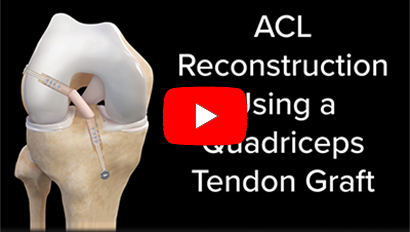
Anterior Cruciate Ligament (ACL) Tears: ACL Reconstruction Using a Quadriceps Tendon Graft
Anterior Cruciate Ligament (ACL) Tears: ACL Reconstruction for Pediatrics Animation
ACL Reconstruction Surgery in Boca Raton, Boynton Beach & Delray Beach, FL
An anterior cruciate ligament (ACL) tear is one of the most common and significant knee injuries affecting athletes and active individuals. When the ACL is torn, patients often experience knee instability, pain, swelling, and difficulty returning to sports or physically demanding activities. ACL reconstruction is a specialized procedure designed to restore knee stability and function by replacing the damaged ligament with a graft. Dr. William P. Toole is a board-certified, fellowship-trained orthopedic sports medicine specialist who performs advanced ACL reconstruction surgery for patients throughout Boca Raton, Boynton Beach, and Delray Beach. Utilizing state-of-the-art surgical techniques, individualized rehabilitation protocols, and a sports-focused approach to recovery, Dr. Toole helps patients return safely to competition, exercise, work, and active lifestyles.
ACL Reconstruction Surgeon in FLorida
Sports that involve twisting or overextending of the knee can cause ACL injuries due to sudden directional change, landing incorrectly from a jump or direct blow to the side of the knee. Dr. Toole; provides diagnosis and minimally-invasive ACL reconstruction surgery in FLorida. Dr. Toole; also provides highly specialized care during and after the surgery. Contact Dr. Toole;'s office for an appointment today!
What is an ACL Reconstruction?
ACL (anterior cruciate ligament) reconstruction is a commonly performed surgical procedure. With recent advances in arthroscopic surgery, it can now be performed with minimal incision and low complication rates.
The advancements in arthroscopic surgery make it easy for surgeons to view and work on knee structures through small incisions. The repair of the torn ligament can be performed at the same time as the diagnostic arthroscopy with fewer surgical risks.
The surgery can usually be performed as an outpatient procedure, which means you may be discharged to go home on the same day as the procedure.
Anterior Cruciate Ligament Tears
The anterior cruciate ligament (ACL) is one of the major stabilizing ligaments in the knee. It is a strong rope-like structure located in the center of the knee, running from the femur to the tibia. When this ligament tears, unfortunately, it does not heal on its own, and often leads to the feeling of instability in the knee.
Causes of an ACL Injury
An ACL injury most commonly occurs during sports that involve twisting or overextending of your knee. An ACL can be injured in several ways:
- Sudden directional change
- Slowing down while running
- Landing incorrectly from a jump
- Direct blow to the side of your knee, such as during a football tackle
Symptoms of ACL Injury
When you injure your ACL, you might hear a loud "pop" sound and may feel the knee buckle. Within a few hours after an ACL injury, your knee may swell due to bleeding from vessels within the torn ligament. You may notice that the knee feels unstable or seems to give way, especially when trying to change direction on the knee.
Diagnosis of an ACL Injury
An ACL injury can be diagnosed with a thorough physical examination of the knee and diagnostic tests such as X-rays, MRI scans and arthroscopy. X-rays may be needed to rule out any fractures. In addition, your surgeon will often perform the Lachman’s test to check if the ACL is intact. During a Lachman test, the knee with a torn ACL may show increased forward movement of the tibia, and a soft or mushy endpoint compared to a healthy knee.
Pivot shift test is another test to assess ACL tears. During this test, if the ACL is torn, the tibia will move forward when the knee is completely straight and as the knee bends past 30° the tibia shifts back into the correct place in relation to the femur.
if you would like to have additional information on the treatment of ACL injury or would like to learn more about ACL reconstruction, please contact Dr. Toole;, serving the communities of FLorida.
Why Choose Dr. William Toole for ACL Reconstruction in Boca Raton, Boynton Beach & Delray Beach?
ACL injuries require specialized care to restore knee stability and optimize long-term athletic performance. Dr. William P. Toole is a fellowship-trained orthopedic surgeon specializing in sports medicine, ligament reconstruction, and complex knee injuries. He treats athletes of all levels, from recreational competitors to high-performance athletes, using advanced ACL reconstruction techniques tailored to each patient's anatomy, activity level, and recovery goals. Dr. Toole emphasizes comprehensive care throughout every stage of treatment, from diagnosis and surgical planning to rehabilitation and return-to-sport testing. His goal is not only to restore knee stability but also to help patients regain strength, confidence, agility, and performance.
ACL Reconstruction FAQs
What is ACL reconstruction surgery?
ACL reconstruction is a surgical procedure that replaces a torn anterior cruciate ligament with a tendon graft. The new graft serves as a scaffold that gradually incorporates into the knee and functions as a new ligament, helping restore stability and normal knee mechanics.
When is ACL reconstruction recommended?
ACL reconstruction is often recommended for active individuals who experience knee instability, athletes wishing to return to pivoting sports, patients with combined ligament injuries, or those whose daily activities are limited by a torn ACL.
Can a torn ACL heal without surgery?
Unlike some ligaments, the ACL has limited healing potential because of its location within the knee joint. While some patients can function without surgery through rehabilitation and activity modification, ACL reconstruction is frequently recommended for patients who wish to return to cutting, pivoting, or high-demand activities.
What graft options are available for ACL reconstruction?
Several graft options may be used for ACL reconstruction, including patellar tendon autografts, hamstring tendon autografts, quadriceps tendon autografts, and donor tissue (allografts). The most appropriate graft depends on the patient's age, activity level, sport, and treatment goals.
How long does ACL reconstruction surgery take?
The procedure is typically performed arthroscopically and often takes approximately one to two hours, depending on the complexity of the injury and whether additional procedures such as meniscus repair are performed at the same time.
What is recovery like after ACL reconstruction?
Recovery is a structured process that includes physical therapy, strength training, balance exercises, and sport-specific rehabilitation. Most patients begin walking shortly after surgery and gradually progress through rehabilitation milestones over several months.
How long does it take to return to sports after ACL reconstruction?
Return-to-sport timelines vary based on healing, strength recovery, movement quality, and functional testing results. Many athletes return to sports between 9 and 12 months after surgery, although some may require additional time to achieve optimal readiness.
Will I need physical therapy after ACL surgery?
Yes. Physical therapy is essential for a successful outcome. Rehabilitation focuses on restoring range of motion, rebuilding strength, improving balance and coordination, and preparing patients for a safe return to sports and daily activities.
Can an ACL tear occur together with other knee injuries?
Yes. ACL tears are commonly associated with meniscus tears, cartilage injuries, bone bruises, and injuries to other knee ligaments. A comprehensive evaluation helps identify and address all associated injuries during treatment.
What are the success rates of ACL reconstruction?
ACL reconstruction has a high success rate when combined with appropriate rehabilitation. Most patients experience improved knee stability, enhanced function, and the ability to return to many of their desired athletic and recreational activities.
Schedule an ACL Reconstruction Consultation in Boca Raton, Boynton Beach & Delray Beach
If you have suffered an ACL injury and are experiencing knee instability, pain, or limitations during sports and daily activities, Dr. William Toole can help. Through comprehensive evaluation, advanced surgical techniques, and personalized rehabilitation planning, he helps patients throughout Boca Raton, Boynton Beach, and Delray Beach recover from ACL injuries and return to active lifestyles. Contact our office today to schedule a consultation and learn more about your ACL reconstruction options.